

Erzberg Iron
In order to consider medieval ironworking and steel production, it’s crucial to also look into the major sources for metal during the Middle Ages. Enter the Erzberg Mine in Styria, Austria.
Steel mined from ore found in the Erzberg mine in Styria, Austria, was understood to be the preferred steel used at Greenwich by the Almain Workshop in large part because the ore from Erzberg is a manganiferous siderite iron ore which produces a high-strength, tough alloy (Wang, 2022; Williams, 2012). It was at the time a weathered spar, but analysis of slag and remnants from sites identified as medieval show that the Iron content was extremely high, with traces of aluminum, silica, and manganese, making it a highly valuable and excellent quality ore (Klemm, Strobl and Haubner 2013). The complex system of ironworks estates, forges, and tradespeople who supplied this steel has been analyzed and considered (Braunstein and Landsteiner, 2011; Toussaint, 1994). There were few other metallurgical centres specialized in the production of steel at the time, and Styrian steel was used for arms, armour, tools, and blades and traded through much of Europe (Williams, 2012).
The ironworking centre was shaped around a series of ironworking estates, called radwerk, owned by local townspeople, who worked with shaft furnaces - stückofen - to smelt the ore they mined from this enormous deposit (which has been worked for 1300 years to date and continues to produce excellent steel today). Steel smelted in these furnaces produced layered material, the finest of which was worked and reworked using water-driven hammers, to produce the very finest steel, called Scharsachstahl.
It was this steel which was then brought to the town of Steyr nearby, from which it was sold throughout Europe and into the great armouries of the Holy Roman Emperor Maximilian I and beyond.
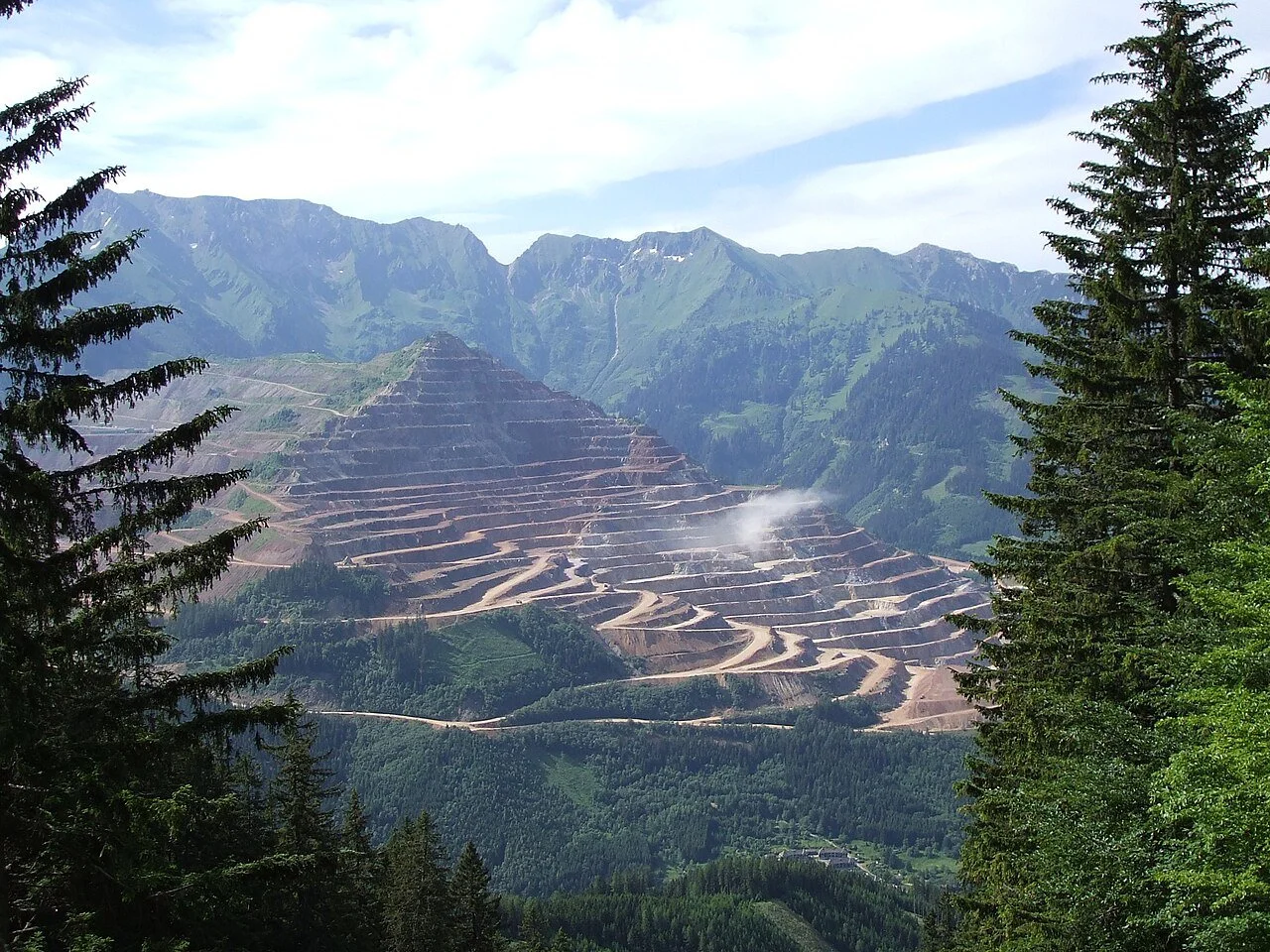
Photograph by I, Senarclens, CC BY-SA 3.0, https://commons.wikimedia.org/w/index.php?curid=2411404
References
Braunstein, Philippe, and Erich Landsteiner. “The Production and Trade of Steel and Steel Tools in the Early Modern Semi-Periphery. A Commodity Chain Approach to the Innerberg District (Austria) in the 16th and 17th Centuries.” in L’acier En Europe Avant Bessemer. 405-446. Toulouse: Presses universitaires du Midi, 2011.
Toussaint, Friedrich. “The Styrian Iron Trail of Austria.” Steel Times 222, 2 (1994): 82–82.
Wang, Dingzheng, Jian Pan, Deqing Zhu, Zhengqi Guo, Congcong Yang, Zhuang Yuan. “An efficient process to upgrade siderite ore by pre oxidation-magnetization roasting-magnetic separation-acid leaching” Journal of Materials Research and Technology 19 (2022): 4296-4307.
Williams, Alan. The Sword and the Crucible: A History of the Metallurgy of European Swords up to the 16th Century. Leiden: Brill, 2012.
